
- Blog EDMS EPC companies Oil & Gas
- 20 Nov 2025
Oil & Gas Compliance Made Easy with EDMS: Here’s How
Why Regulatory Compliance in Oil & Gas Remains a Challenge
The Oil & Gas industry operates within some of the strictest regulatory environments in the world. EPC companies must comply with hundreds of standards, permits, statutory approvals, and industry codes that evolve continuously. Yet, despite years of process maturity, compliance continues to be a major challenge. This is largely because many organisations still depend on manual coordination, spreadsheets, emails, and human oversight to manage complex compliance workflows. Such human-dependent processes are slow, expensive, difficult to standardise, prone to errors, and nearly impossible to audit in real time. In an industry where a single oversight can lead to delays, safety risks, rework, or financial penalties, traditional manual approaches are no longer viable.
Why Traditional Compliance Systems Fall Short

It may seem logical that a process-driven industry like Oil & Gas should have compliance under control by now. But in reality, compliance processes are still managed by people rather than systems, creating significant inconsistencies. Teams often face missed workflow steps, reactive decision-making instead of proactive prevention, and challenges in demonstrating compliance during audits. Many EPC companies have robust Quality Plans, but without a digital enforcement mechanism, there is no guarantee that these plans will be followed consistently. As a result, quality control becomes a retrospective exercise instead of ensuring discipline at the execution stage.
Why EDMS is Critical for Enforcing Compliance
An Engineering Document Management System (EDMS) addresses this long-standing gap by transforming compliance from a manual task into an automated, system-driven process. Every project begins with a Project Quality Plan (PQP) detailing workflows, responsibilities, standards, approval mechanisms, and documentation requirements. But a PQP only defines expectations; it does not ensure enforcement. This is where EDMS plays a crucial role. Without EDMS, errors are only identified after they occur. With EDMS, every workflow step is automated, approvals follow predefined routes, deviations are prevented unless authorised, and all documentation is captured digitally at the source. For example, during an Inter-Discipline Check (IDC), the EDMS automatically manages the sequence of reviews, approvals, and revisions, ensuring no step is missed and maintaining complete traceability.
Effortless Audit Readiness Through Digital Records
Audit cycles in the Oil & Gas sector are often stressful, involving extensive document retrieval, delayed payments, and rework caused by missing evidence. With EDMS, every action—from review steps to approval timestamps—is recorded digitally. This eliminates the need for manual document collection during audits. Instead of spending days searching for proof of compliance, organisations can present accurate audit-ready information within minutes. The system becomes a single source of truth, ensuring transparency, accuracy, and confidence during internal and external assessments.
From Quality Control to Quality Assurance With EDMS

EDMS fundamentally changes how EPC companies manage quality. Instead of identifying errors after they occur, the system ensures that mistakes are prevented at the source. Compliance becomes automatic rather than a responsibility left to individuals. Teams spend less time tracking documents or following up on approvals and more time on productive engineering work. Standardised workflows, consistent quality enforcement, and the elimination of process deviations enable companies to achieve true quality assurance. This is why leading EPC companies across India, Qatar, UAE, Saudi Arabia, Malaysia, Singapore, and Australia are now integrating EDMS as a core pillar of their digital transformation.
Digital Compliance Is Now a Business Necessity
As projects become larger, more complex, and more regulated, relying on manual processes is no longer sustainable. An EDMS ensures comprehensive regulatory compliance, workflow standardisation, audit readiness, enhanced engineering productivity, and timely project delivery. With EDMS in place, companies no longer struggle to control quality—they achieve guaranteed quality assurance built into every stage of the project lifecycle.

Related Posts
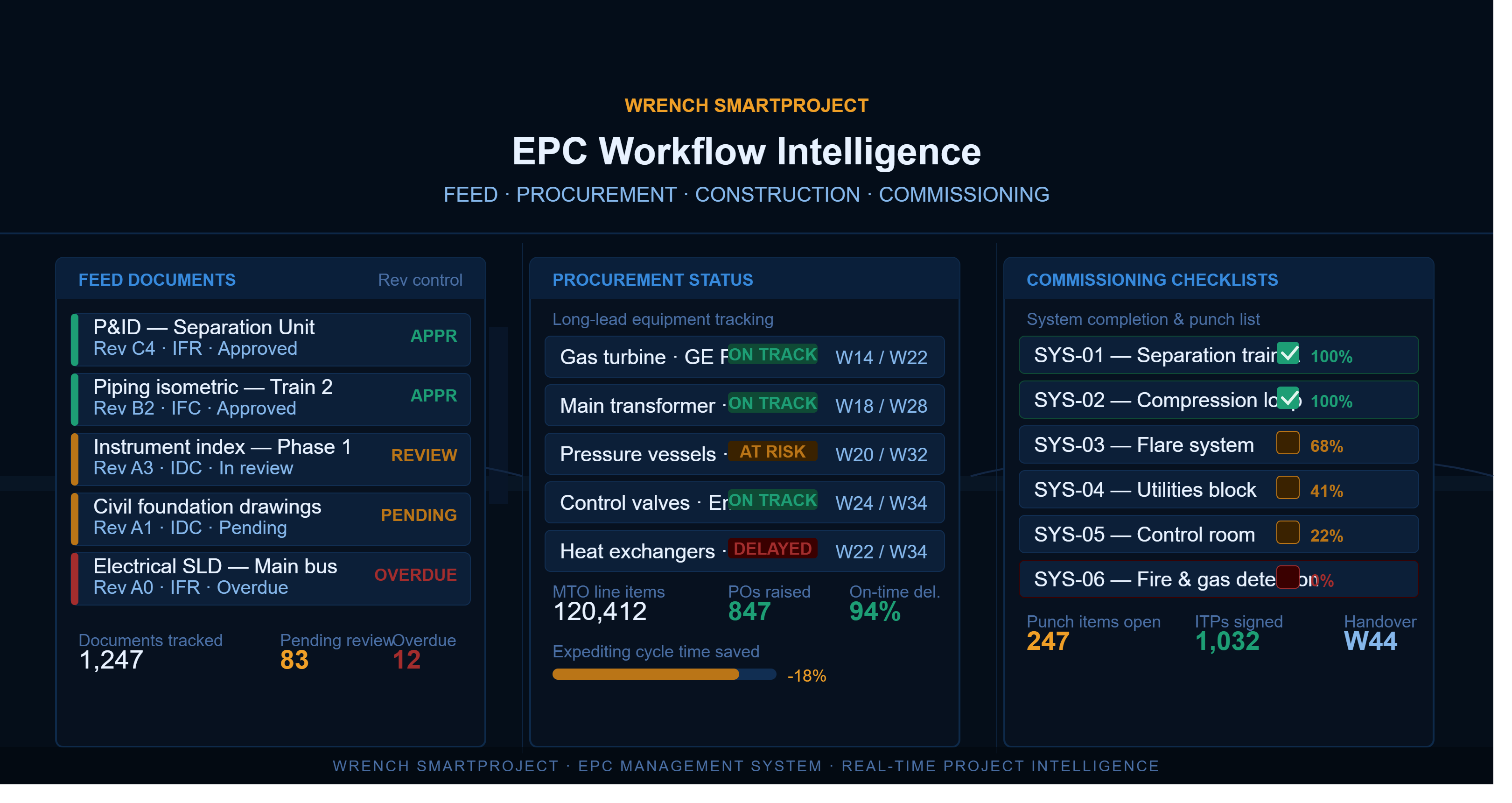
Engineering Workflow Software for Oil & Gas: FEED to Commissioning
Why HSE Matters More Than Ever The oil and gas EPC market was valued at approximately $57.8 billion in 2023 and is projected to reach $83.6 billion by 2032. Behind every billion-dollar capital project is…

- 19 Jun 2026

EPC Workflow Management for Power Plant Projects: Challenges & Tools
Power generation and transmission projects rank among the most complex and tightly regulated capital projects in the EPC world. Whether it is a combined-cycle gas turbine (CCGT) plant, a coal-to-gas conversion, a nuclear facility, or…
- 16 Jun 2026