- Blog Capital Projects CDE EDMS EPC project management system Power
- 16 Jun 2026
EPC Workflow Management for Power Plant Projects: Challenges & Tools

Power generation and transmission projects rank among the most complex and tightly regulated capital projects in the EPC world. Whether it is a combined-cycle gas turbine (CCGT) plant, a coal-to-gas conversion, a nuclear facility, or a utility-scale solar-plus-storage project, the engineering, procurement, and construction workflows involved are extraordinarily intricate — and the cost of getting them wrong is enormous.
Investment in power generation structures is projected to grow by nearly 1.8% in 2026, with AI-related data center outlays and energy transition projects sustaining engineering and construction demand. For project directors and engineering managers working in this sector, understanding how to manage multi-discipline workflows from FEED to commissioning is the difference between a profitable project and a costly overrun.
The Unique Challenges of Power Plant EPC Projects
Power plant projects combine the complexity of heavy industrial engineering with strict regulatory oversight. They involve civil and structural, mechanical, electrical, instrumentation and controls, HVAC, and process engineering disciplines — all of which must produce interdependent deliverables on a tightly sequenced schedule.
Key challenges specific to this sector include:
- Long lead equipment: Gas turbines, generators, transformers, and boilers have delivery timelines of 18 to 36 months. Any misalignment between the engineering design and procurement status can halt construction.
- Regulatory and permitting complexity: Power plant projects must satisfy environmental impact assessments, grid interconnection approvals, and regulatory authority inspections — each requiring precise, up-to-date documentation.
- Multi-contractor coordination: EPC contractors frequently manage numerous specialist subcontractors — civil, structural steel, mechanical, electrical — all operating in parallel. Workflow visibility across these parties is critical.
- Commissioning and load testing: Power plants require rigorous pre-commissioning, commissioning, and performance testing phases, each with detailed Inspection and Test Plans (ITPs) and punch list management.
How Engineering Workflow Software Solves These Problems
Modern EPC workflow management platforms address these challenges by providing a unified, real-time view of all engineering, procurement, and construction deliverables. For power plant projects specifically:
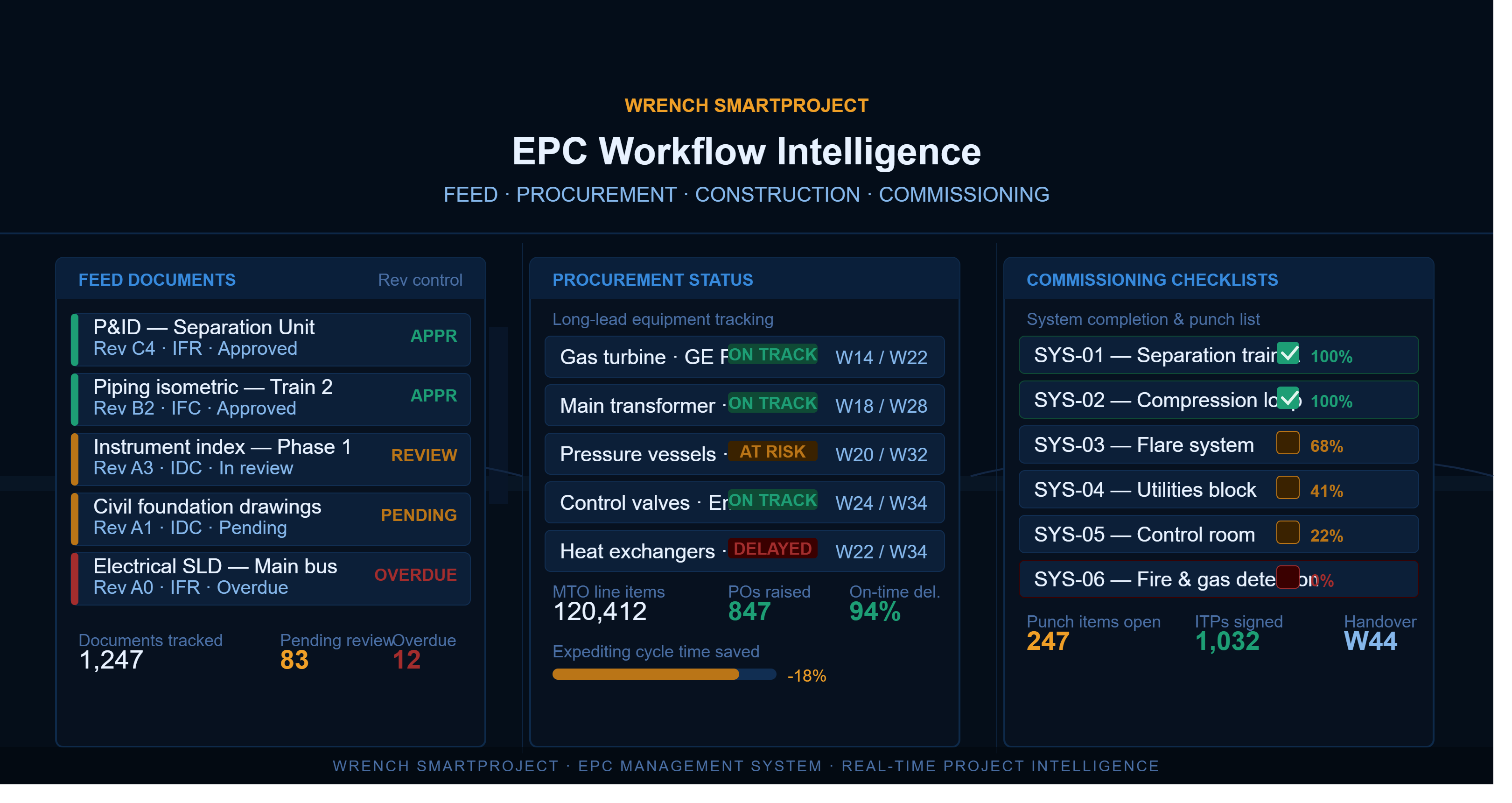
Document control and transmittal management ensure that every drawing, specification, and vendor document is tracked through its full revision and approval lifecycle. Automated workflows route documents to the right reviewers with defined timelines, preventing bottlenecks that delay procurement and construction decisions.
Procurement workflow integration ties long-lead equipment requisitions directly to engineering document status. When a P&ID is approved, the procurement workflow for associated equipment is automatically triggered, maintaining schedule alignment.
Construction progress tracking through mobile applications allows field teams to capture actual quantities against planned distributions, track Work Pack completion, and log quality and HSE observations — all in real time.
The Role of Primavera Integration
Power plant projects are typically scheduled in Primavera P6, with thousands of activities linked across engineering, procurement, and construction. Engineering workflow software that integrates directly with Primavera P6 allows project controls teams to correlate document completion percentages with schedule milestones, providing early warning of delays before they become critical path issues. Wrench SmartProject EPC MS enables this integration natively, giving project directors a single dashboard that bridges the gap between the document world and the schedule.
Commissioning Readiness: The Critical Final Phase
A power plant is not complete until it successfully passes commissioning tests and performance guarantees. Engineering workflow software that manages system completion, punch list closure, and the compilation of operating and maintenance manuals ensures that handover packs are complete and compliant — dramatically reducing the risk of commissioning delays and post-handover disputes.
Conclusion
An Engineering Document Management System (EDMS) gives power plant EPC teams a single, auditable repository for every drawing, specification, and vendor document — keeping multi-contractor workflows aligned from FEED through load testing.
Sajith is a Graduate Engineer and certified Project Management Professional from PMI who carries 30 years of industry experience. He has deep domain expertise in EPC who worked with major EPC Contractors and owner organisations in the Oil & Gas sector, including Petrofac, KNPC, KIPIC, Chevron, Almeer, BPL Ltd etc.. Sajith has executed EPC projects valuing around 500 M USD, and has been associated with a 16 billion USD new refinery project in Kuwait.
Related Posts
Engineering Workflow Software for Oil & Gas: FEED to Commissioning
Why HSE Matters More Than Ever The oil and gas EPC market was valued at approximately $57.8 billion in 2023 and is projected to reach $83.6 billion by 2032. Behind every billion-dollar capital project is…
- 19 Jun 2026

Document Control vs. Engineering Data Management: What EPC Teams Actually Need
In EPC project environments, the terms ‘document control’ and ‘engineering data management’ are often used interchangeably — but they describe fundamentally different functions, and confusing them leads to purchasing decisions that leave critical project gaps….

- 12 Jun 2026
Archives
- June 2026
- May 2026
- April 2026
- March 2026
- February 2026
- January 2026
- December 2025
- November 2025
- October 2025
- September 2025
- July 2025
- June 2025
- April 2025
- March 2025
- February 2025
- January 2025
- November 2024
- October 2024
- September 2024
- August 2024
- July 2024
- June 2024
- May 2024
- April 2024
- March 2024
- January 2024
- December 2023
- November 2023
- September 2023
- August 2023
- July 2023
- June 2023
- May 2023
- April 2023
- March 2023
- February 2023
- January 2023
- December 2022
- November 2022
- September 2022
- June 2022
- May 2022
- April 2022
- March 2022
- January 2022
- November 2021
- October 2021
- July 2021
- June 2021
- May 2021
- March 2021
- February 2021
- January 2021
- December 2020
- November 2020
- September 2020
- August 2020
- June 2020
- April 2020
- March 2020
- February 2020
- January 2020
- November 2019
- October 2019
- September 2019
- August 2019
- April 2019
- March 2019
- December 2018
- October 2018
- September 2018
- August 2018
- July 2018
- June 2018
- May 2018
- April 2018
- January 2018
- November 2017
- October 2017
- September 2017
- May 2017
- April 2017
- March 2017
- February 2017
- January 2017